Tuesday, January 31, 2017

Hockeyviz/SB Nation Wraparound - January 31st

It's been a while since we've done a wraparound, and it's also been a while since any meaningful NHL hockey was played. So, to help us get back in the swing of things for the second half of the year, we're going to use this space to look around at the current state of the league. 

Normally, I use HockeyViz to provide visuals after we see what's going on with certain teams. Today, I'm going to let HockeyViz dictate which teams we're going to look at. Let's see who's almost certainly a lock for the playoffs:


I'm going to draw the cutoff at the four teams in each conference that haven't needed a recent surge to climb to the top. That leaves us with Minnesota, San Jose, Chicago, and Anaheim out West, and Washington, Columbus, Pittsburgh, and Montreal in the East.

We'll start with the four West teams, and then maybe tackle the East this afternoon.

Minnesota Wild (Hockey Wilderness)

Wilderness Walk: Hockey’s back by mntrumpterguy (link)

There isn't a whole lot of original content on HW today because of the All-Star break, but they do an excellent job of rounding up all of the links in the hockey media world that mention the Wild. Here are some excerpts from the summaries of those links:
A quiet and steady leadership Koivu has guided the Minnesota Wild through the storms of the past and is a reason why they are on top of the conference. 
I’m not sure I know where to start with this rendition of the Minnesota Wild. This situation really isn’t normal.
It’s safe to say that the Minnesota Wild have surprised everybody with their success in the first half of the 2016-17 NHL season.
The Wild is one of the best scoring teams in the NHL this season.
You might be sensing a common theme there: the Wild are good, and nobody really knows how. Is it really just as simple as Bruce Boudreau being a great coach? Is this like last year's Penguins team that had a ton of talent and just needed someone to use it properly? Let's dive in.


Look especially hard at the Shooting Percentage segment of that visual. If you're consistently scoring on more of your shots than your opponent, you are going to be a successful hockey team (#ThanksCaptainObvious). Devan Dubnyk has been stellar this year, but part of the credit for that success has to go to the Wild's team defense. I mean look at the shots that Dubnyk faces:


That is an enormous blue hole, and it is a marked improvement from last year's team defense (which was not bad by any means):


Minnesota plays the style of hockey that should have them on the road to postseason success, which is why they're second in the Western Conference at +800 to win the Stanley Cup. Now, let's jump to the only team ahead of the Wild in that list.

Chicago Blackhawks (Second City Hockey)

Of fucking course the Blackhawks have narrower odds to win the Cup than anyone in the West. They also had more players in the All-Star Game than anyone in the league. And also more players named to the NHL's Top 100 Players Of All Time list than any other American team. So let's try to make this section as negative as possible.

Morning Bag Skate: Blackhawks limp into NHL All-Star break by Brandon M. Cain (link)

Obviously the word "limp" is used pretty liberally there, because they're in second place in the Central Division with a 9-point cushion over the third place Nashville Predators. Apparently, when you are in the middle of a dynasty, a 2-game losing streak that drops you from first place to second is worth complaining about. 

God damn the Blackhawks. 

The MBS post did link to a CSN Chicago article about Richard Panik's increased production this year, so let's take a quick look at the future Vegas Golden Knight. 

Essentially, Panik spent the first quarter of the season on a line with Jonathan Toews (and sometimes Patrick Kane). He spent the second quarter of the season playing in more of a third-line (fourth-line?) role with Marcus Kruger and Dennis Rasmussen. And in the last five Hawks games before the break, he was paired with Toews again (this time Ryan Hartman was on the other wing). 

It should be noted that 9 of Panik's 12 goals (and 12 of his 19 primary points) this season came during the games where he was primarily playing with Toews. Panik is a fine complement to Captain Serious, but Toews is essentially the same player with or without Panik on his wing. 


Useful top-nine forwards are never a bad thing, especially for a team like Chicago that can build their top three lines around three Hall Of Famers and the Rookie Of The Year. 

But to get back to that Vegas/expansion draft comment I made before, I would be really hesitant to sign Panik to a long-term contract that gives him a significant raise on his current $875k salary. I'm sure he will get a big check from someone, and it will probably end up biting them in the ass because he won't be playing with Jonathan Toews. 

San Jose Sharks (Fear The Fin)

One common "trade deadline" thought that seems to be pretty prevalent in the NHL is the Sharks should be buyers at the trade deadline. They're going to make the playoffs, and the contracts of longtime leaders Joe Thornton and Patrick Marleau expire after this season. It would make sense, therefore, for San Jose to go all-in for one last run before they officially turn the page over to the Pavelski-Couture-Burns section of their Wikipedia page. 

But let's look at the other side of things.

Why it might make sense for the Sharks to stand pat at the trade deadline by Jake Sundstrom (link)

I feel like this blog could just be "Let's see how shit plays out without overpaying for other people's trash." But Jake really went top-to-bottom here. 
..there aren’t many guys who are in San Jose’s budget that would provide an upgrade on the fourth line.. With a fourth line of Timo Meier - Chris Tierney - Melker Karlsson I find it hard to believe there’s a cheap trade out there that makes for San Jose.

That leaves a blockbuster; or at least a midsize hit. That’s the kind of move the Sharks should be looking for at this deadline. The kind of move that leaves them with cap flexibility for the next couple of offseasons while helping them out in the upcoming expansion draft, if possible.

The kind of trade I’m talking about is one that sheds a contract like Joel Ward’s or Paul Martin’s, freeing up a spot for one of the young guys with the Barracuda to earn a spot with the team. I absolutely don’t think that’s going to happen, but that’s the kind of trade that I think helps San Jose the most in the long term.

This team is already good enough for a Stanley Cup run. Now’s the time to make sure it’s good for one next June, too.
Before I say anything, I'd like to be clear that I acknowledge that he said he doesn't think it's going to happen, and this post probably kind of spiraled for him at the end.

But trading two veterans before a "last hurrah" kind of Stanley Cup run is maybe the worst front office move I have ever heard in my life. Ward is on the books for $3.275 next season and then he expires. Martin is due $4.85 million for next year and the following, and then he's gone. These are not big cap hits for an extended term.

For reference, Thornton and Marleau's contracts make for a combined $13.4 million coming off the Sharks' books this summer. Even if they both return for one more go-around, they're going to be a hell of a lot cheaper than these contracts they signed in their primes.

The most egregious part of all is Ward and Martin are the two exact kinds of players that fringe contenders try to acquire at the trade deadline. They are both NHL veterans of 10+ years and they have nearly 200 games' worth of playoff experience between them. They're old, sure, but they're still useful players in terms of actual hockey too. Back me up here, HockeyViz:


Now, admittedly, a lot of that hotness in the offensive zone comes from the fact that Martin plays the vast majority of his shifts with Brent Burns (like, actually almost every single minute that Martin plays). But that's not a knock on Martin, because those two are outstanding together.


Is a sure-thing partner for your $8 million cornerstone defenseman worth $4 million? Yeah, I'd probably say so. But what about Ward? Why is he worth $3 million next year?


Basically, he's going to stand in front of the net and try to score the puck with pure grit. No stick, no skates, just heart and toughness. He also has the impressive ability to drag fourth-line guys like Matt Nieto, the aforementioned Chris Tierney, and Tommy Wingels (RIP).


You overpay veterans in the NHL. That's how it works. Joel Ward is, almost certainly, worth more to the Sharks than he would fetch on the trade market. I would like to formally disagree with Jake on the matter of the San Jose Sharks' future. 

Thursday, January 26, 2017

The NHL 100 Is Hockey's Hottest Thing To Argue About

The NHL's Top 100 Players Of All Time list is really hot in the streets now. If you've missed the talk around it, essentially the league is listing (but not ranking) the best 100 hockey players to ever play to honor the 100 year anniversary of the NHL.

The whole thing is essentially just something to enrage Hockey Twitter, because How The Fuck Are They Going To Leave Eric Lindros Off Of The List and other complaints.

But some actual hockey writers - as opposed to internet commenters - put their heads together and released a detailed book to allow them to put themselves in the shoes of the NHL panel that was creating the official list. They created their own list, and the actually ranked it. I imagine that it was as stressful a sports book as has ever been published.

That book is The 100 Greatest Players In NHL History (And Other Stuff) by Greg Wyshynski, Dave Lozo, and Sean McIndoe. It's 110 pages long, and - fun fact - you can't buy a paper copy. It's a Kindle exclusive.

McIndoe, of course, is also known as Down Goes Brown on Twitter, and he's among the best league-wide hockey writers in the business. In his piece today for Sportsnet (link here), McIndoe elaborated on the eight things he learned in the creation of his Top 100 list. It's a great read, especially for those of us who don't understand the minute details of old-time hockey.

One passage caught my attention, and I think it's an important discussion for hockey fans to have: how much did Wayne Gretzky overshadow everyone else who played in the same era?
When we were building our list, we rated each player in various subjective categories. But we also had a column for major awards, because that seemed like a sanity check..
And in general terms, that worked. But then you get to 1980, and you run into a problem: Wayne Gretzky. He wins a ridiculous eight straight Hart Trophies, a streak that doesn't end until 1987. And when it does, Mario Lemieux steps in and wins three of his own. Mix in one more for Gretzky and two for Mark Messier, and that barely leaves any room for an entire generation of centers. 
The same is true of first-team all-star honours, where Gretzky and Lemieux combine to take home 13 out of 17 honors from 1981 to 1997. And when it comes to the Art Ross, Gretzky, Lemieux and Jaromir Jagr combine for a stunning 21 straight wins.
We'll use that 21-year window of Art Ross Trophy victories (1980-2001) as our point of reference, to see who was overshadowed by that dominant Gretzky-Lemieux-Messier-Jagr quartet. Because there's no doubt that those four are among the best to ever play hockey, and I'm sure their hogging of all the major awards is going to reflect poorly on the legacy of some other good-to-great players.

For reference, here are the awards we are going to care about:

  • Hart Memorial Trophy, for the league's most valuable player
  • Art Ross Trophy, for the league's top point scorer
  • Conn Smythe Trophy, for the league's most valuable player in the playoffs
The Conn Smythe, to be sure, is a more volatile award than the regular season awards. It generally goes to a player of the team that won the Stanley Cup, and there are only like two dozen games to establish one's case for the award. But the playoffs are where heroes are made, or whatever, so we're going to include it. At the very least, it will allow us to see who else should be in contention for these "Top 100" lists from that era. 

In those 21 (or 22?) years from the 1979-80 season through the 2000-2001 season, Gretzky won 9 Hart trophies, 10 Art Ross trophies, and 2 Conn Smythe trophies. Lemieux won 3 Harts, 6 Art Rosses, and 2 Conn Smythes. Messier won 2 Harts and a Conn Smythe. Jagr won 1 Hart and 5 Art Rosses. 

So, if you're keeping score at home, of those 22 seasons (I did the math) (I counted on the Hockey Reference website with my mouse), that quadrumvirate won 15 Hart trophies, 21 Art Ross trophies, and 5 Conn Smythe Trophies. 
 
Who else was even good in those two decades? Let's look at some options.

Art Ross Trophy Winners

Marcel Dionne

We'll start with the only other guy to win the Art Ross trophy, though it was the very first year we were tracking. Dionne, who came up with the Red Wings organization and played the bulk of his career with the Kings, won his first and only Art Ross in the 1979-80 season. He was still certainly a competitive player after Gretzky took over, and he was in contention for first-team All Star and Lady Byng (the sportsmanship award) honors through the mid-80's. 

He finished his career with 1,348 games played and 1,771 points, and I imagine he will be on almost everyone's Top 100 list. But he's probably from the generation right before we're looking to explore for this exercise. 

And now we've determined that every Art Ross Trophy in the time period we're looking at was won by one of those Gretzky-Lemieux-Messier-Jagr guys. What about Hart trophies? Who else won those?

Hart Memorial Trophy Winners

Brett Hull

Hull was the league's MVP in 1990-91, in the middle of a five-year stretch in which he scored 339 goals (!) and 551 (!!) points. That's an incredible peak, and it's almost even more impressive that he followed those five years up with ten more years where he averaged 32.8 goals and 69.0 points. 

I think he's unquestionably on the list. We should just move on. 

Oh yeah, about that average yearly point total - nice. 

Sergei Fedorov

Federov's Hart came three years after Hull's (Messier and Lemieux were the meat on that sandwich). That 1993-94 season came toward the front end of his 13-year tenure in Detroit, and it was such an impressive season for him that he also won the Ted Lindsay award (the NHLPA's MVP) and the Selke trophy (given to the best defensive forward). 

Over the course of his career, he was a top-25 finisher for the Hart 4 times and for the Selke 11 times. In an era where 100-point seasons were the norm for star players, he managed to be one of the best defensive centers in the NHL. 

Eric Lindros

Big E is a Hall of Famer and one of they most physically gifted players to ever play the sport of hockey. His lone MVP season was the year after Fedorov's, 1994-95. In a lockout-shortened 48-game season, Lindros scored 29 goals and 70 points. That's a 50-goal, 120 point pace for a full season, which is right around what he accomplished the following season (47-115). 

The question with Lindros, of course, is his lack of longevity. Whereas Hull and Fedorov both had 15-year peaks, Lindros stormed on the scene with 7 Hart-conversation-worthy seasons followed by a rash of injuries and decreased production. 

The other argument you can make against Lindros, though it really sucks for me to have to acknowledge it, is the fact that Hull won two Stanley Cups, Fedorov won three, and Lindros made the Eastern Conference just three times (they lost to the Red Wings in their only Cup Final appearance). Like it or not, that counts. 

And, because I am a huge homer: if the Quebec Nordiques, the New York Rangers, and the NHL didn't conspire to try to fuck the Flyers out of acquiring Lindros, they would have been able to add two first-round picks to their roster. And, because hindsight it 20/20, obviously those picks would have been Saku Koivu in 1993 and Jose Theodore in 1994. 

Dominik Hasek

Speaking of Theodore, let's bring up the goalie that is most closely associated with him. Hasek, who was always so underpaid that he couldn't afford a real goalie helmet, is the only goalie to win the Hart twice. He also did it in back to back years, and he dominated (pun intended) the league during the 1996-97 and 1997-98 seasons. 

In this aforementioned era where 100-point players were common, Hasek had a six-year peak with a save percentage of 0.930. His total Goals Saves Above Average during that window was 296.5 0- that's an average of 0.82 goals per game, which I have to imagine is the highest measure of a goalie making up ground for his team ever. 

For reference, Carey Price's Hart trophy season saw him total 36.70 GSAA, which would have put him just 0.31 goals above Hasek's worst year in that span. 

Chris Pronger

I wish Corsica and Hockeyviz were around for Pronger's prime. He is, of course, still an active NHL player, but he hasn't really played since November 2011. His prime, if we're looking at his career chart, probably spanned from his rookie season with Hartford (1993-94) to his final full season in Philadelphia (2010-11). The peak, of course, was the 1999-2000 Hart trophy right in the middle, when he was a member of the St. Louis Blues. 

Pronger, because he is a defenseman, doesn't have stats that blow you away like some of the other guys we've looked at here. For his 2 years in Hartford plus his 9 years in St. Louis (he was traded for Brendan Shanahan between those stops), he was usually good for 5-15 goals, 30-60 points, 100-ish penalty minutes, and a whole hell of a lot of "that guy is tough to play against."

But other than his 6'6", 220-pound frame, what made him tough to play against? Was he excellent at transition defense? Did he have a way of winning puck battles in his own zone? Was his 6% career shooting percentage deceptively low? 

I'm asking these all rhetorically, because I have no idea how they evaluated defensemen before advanced stats were a thing. Obviously he was good at something or some combination of things, because he won the Norris trophy for being the league's best defenseman the same season he won his Hart for being the overall MVP, and he finished in the top fifteen in Norris voting 12 separate times from 1996-97 to 2010-11. 

Joe Sakic

Sakic played 20 season in the NHL. They were all with one franchise. That is unique. The franchise was the Quebec Nordiques and then it became the Colorado Avalanche (insert PFT Commenter-style joke about leaving French Canada for Denver). 

Folks, it looks like Sakic and the boys left (something racist about French Canadians) and (something about marijuana). Nailed it. 

Anyway, Joe Sakic. He epitomizes everything I was trying to do with this exercise. He played from 1988 until 2008 (like Pronger, he ended his season in November). That first half of his career was played in the seasons during which Gretzky won his final Hart, Messier won both of his, and Lemieux won all three of his. 

Sakic bid his time to let those guys get out of the way, and then finally led his team to be an annual playoff contender for the second half of the 90's (and beyond, obviously). He didn't win his MVP award until his age-32 season, despite more than a decade of elite play. He was always great - he finished 8th in Calder Memorial trophy voting his rookie year and 7th in Hart trophy voting two years later - but he really couldn't shine until the real cream of the crop aged past their competitive primes. 

Jaromir Jagr, of course, does not age.

Jose Theodore

I was going to end this with Sakic because his Hart year was the last season in which the Gretzky-Messier-Lemieux-Jagr group won their consecutive Art Ross trophies. 

But we've already mentioned Theodore here in the Lindros section, and he won the Hart trophy after Sakic in 2002. The long-time Canadien and one-time Av, Cap, Wild, and Panther certainly peaked in the 2001-02 season. It was the only season he got Vezina votes, and one of only two seasons he got Hart votes (he finished 19th in 2003-04 but didn't receive a single Vezina vote. 

If you're wondering how he could have received 1 second place, 2 fourth place, and 1 fifth place vote for MVP but not a single vote for first, second, or third for the league's best goalie, that would be because the Hart is awarded by the Professional Hockey Writers' Association and the Vezina is awarded by NHL general managers. Take from that what you will. 

There is another reason that we should discuss Theodore here, and it has nothing to do with hockey. He won the Bill Masterton Memorial trophy in 2009-2010 as the player who "best exemplified the qualities of perseverance, sportsmanship, and dedication to hockey." 

Like the Hart trophy, the Masterton is awarded by the PHWA. While his votes in 2003-04 might not have been warranted, this award was almost unquestionably earned. It is a heartbreaking story, so prepare yourself to get emotional. 

Theodore's 2009-10 season - his best since his Hart season - came following the death of his two-month-old son. I would like to urge you to read this Washington Post interview with Theodore, whether you're unfamiliar with the story or just haven't thought about it in a while. 

This post took us all over the place, and in a way I'm glad we got to include Theodore. His story is as emotional as humanly possible, and his work to raise money for the NICU at Children's National Medical Center has no doubt saved hundreds of parents from experiencing the loss that he and his wife had to endure. 

I don't really know how to close this, because this emotional ending really snuck up on me at the end of the work day. So I'll close with two quotes from Jose about loss and moving forward: 
"I was so angry and frustrated and sad and everything you can imagine," Theodore said. "I was just going on the ice, wanting to practice so hard to make up for lost time."
"I don't like the word 'easier,' " he said. "It's more like you deal with it."

Wednesday, January 18, 2017

Steve Mason To The Stars?

Let me preface this post by saying I have very little knowledge about the direction Ron Hextall is looking to steer the Philadelphia Flyers. I have even less knowledge about what (Googles the Stars' GM) Jim Nill is trying to do with the Dallas Stars.

But here's what I do know: the Stars' goalies stink, the Flyers' goalies stink, and the Stars' goalie coach seems to have a positive impact on Steve Mason when they work together.

So obviously we're going to ship Mason to Dallas, and in return we're going to try to fill the Dynamic Scoring Winger hole that the Flyers have had, quite literally, forever.

Flyers receive: G Antti Niemi, RW Brett Ritchie
Stars receive: G Steve Mason

Here's my rationale from the Flyers standpoint for each of those pieces:

  • Mason - I don't necessarily want him gone, but this exercise doesn't work unless we accept that as a given. Let's wash that $4.1 million cap hit right out of the books, and more importantly let's not sign him to a 5-year, $25 million contract this summer. 
  • Niemi - Despite what you might be thinking about the Stars' goaltending situation, Niemi actually started the season as a decent goalie. Since then, he's fallen off a cliff and he has been especially shaky in the last month or so.  But he can't possibly be much more shaky than Mason has been lately. Niemi would be the goalie that the Flyers exposed to Las Vegas, and obviously he wouldn't be claimed because the Knights are going to sign Ben Bishop obviously. This would allow them to protect Anthony Stolarz without having to commit money to a goalie to stand in his way for 3-4 additional years. Hextall would be free to turn the reigns over to Stolarz at the start of the 2018-19 season. But the real prize of this trade is this next bullet. 
  • Ritchie - He is a 23-year-old former second-round pick. He makes less than $900k per year, and he's a restricted free agent this summer. He also leads the Dallas Stars in 5-on-5 Goals Per Sixty Minutes. In fact, he would have the highest 5v5 Goals/60 of any Flyers winger except Michael Raffl (who is a mere 0.02 ahead of him). This nose for the net - and the 9 goals that have come from it - are in spite of the fact that Ritchie's most common linemates this season are Radek Faksa and Antoine Roussel. There is almost certainly some kind of positive effect from sheltering in play here, but look at the effect Ritchie has on the Stars' shots:

He doesn't get to play with Jamie Benn or Tyler Seguin, but Ritchie certainly does something right in the offensive zone. 

I think all three of those bullets above are defensible for Philly. But does it make sense from the other side of the table? Here's what I can come up with for Dallas:

At first glance, the Stars are going into this summer with a great cap situation. Jamie Benn's contract explodes from $5.25 million to $9.5 million, but they'll offset that and more with the expiration of the over-thirty brigade, made up of Patrick Sharp ($5.9 million), Ales Hemsky ($4 million), Johnny Oduya ($3.75 million), Jiri Hudler ($2 million), Patrick Eaves ($1 million), Lauri Korpikoski ($1 million), and Adam Cracknell ($600k). Ryan Garbutt's $900k that was retained in his trade will also disappear. 

And then if you throw Mason's expiring $4.1 million on top of it all, the Stars would have $19 million to fill out their roster. The only RFA that I believe would be due a significant raise would be Jamie Oleksiak, and so the Stars would essentially have $18 million to spend on a top-six winger, 1-2 depth forwards, a depth defenseman, and a backup goalie. Maybe - and here's a crazy thought - instead of just signing a depth defenseman, they splurge and steal Kevin Shattenkirk from the Blues. 

If - and that is a humongous "if" - Ritchie isn't a critical part of Nill's plan for the Stars, this might make sense for him. If I am wildly undervaluing Ritchie's contributions, then perhaps Michael Del Zotto would find his way into this trade somehow. I'm sure he wouldn't mind playing with his old pal Tyler Seguin for a while. 

But unless the Stars are going to carry Lehtonen and Niemi through the duration of both of their contracts, they're going to have to give away an asset for the right to drop one of them from the books. Ritchie could wind up being that asset, though again let me stress that I don't know anything about anything. 

But if we're connecting the dots, which is really the most important thing when it comes to trade rumors, we have an interesting web. Mason reuniting with his old goalie coach, Del Zotto finally linking up with Seguin, and the Stars trading away a solid young player to dump one of their two overpaid goalies seems like it might all combine to make sense. Philly would get better in the short-term (and maybe the long-term too), and Dallas would also improve, especially if MDZ was thrown into the mix. I'm rambling now. This is never going to happen. 

Tuesday, January 17, 2017

Hockeyviz/SB Nation Wraparound - January 17th

Hi friends, happy Tuesday, and happy bye week to all of my fellow Flyers fans. The orange and black have hit a month-long rough patch and they're going to be out of the playoff picture by the time they play their next game. Let's try to forget they exist for a while and focus on what else is happening around the league.

Given how gloomy it is right now in Philadelphia (both because of the Flyers and because of the weather), we're going to try to make this entire wraparound focus on positive, happy things that are happening in the NHL.

There is a very obvious place for us to start.

Penguins 8, Capitals 7 (OT)

Penguins vs. Capitals might go down as the best NHL game of the season by Pat Iversen (link)
The Capitals took a 3-0 lead. Pittsburgh erased it with six unanswered goals, part of a nine-goal (!!) second period. Washington scored twice in the third to tie it. And Pittsburgh won in OT. Final score: 8-7. Fifteen goals between two of the NHL’s best rivals.
“That second period was one of the craziest periods I’ve been associated with,” [Pittsburgh coach Mike] Sullivan said. “I don’t even know how to assess it.”
Obviously, a game that featured fifteen total goals was either a laughable blowout, an evenly-matched display of offense, or a really poor showing by two goalies. Considering the game went to overtime and was decided by one goal, it's tough to call it a blowout. But as for the good offense/bad goaltender discussion, I would say it was more of the latter than the former.

Per Corsica, nearly 48 of the 61 minutes were played at even strength. The Capitals had four power play opportunities, and the Penguins had just one. Here are the shot charts for both teams:


That Eller goal was actually shorthanded, not on the power play. The Caps' vaunted power play finished the night 1/4, and they allowed the Penguins to score on their lone chance with the man advantage. Considering the personnel on both sides, neither of those numbers is outrageous.

What is outrageous is the horrible goaltending from Pittsburgh's Matt Murray (21 saves on 28 shots) and Washington's Braden Holtby (21 saves on 26 shots) and Philipp Grubauer (8 saves on 11 shots). Sure, there was a ton of offensive talent on the ice. But for the reigning Vezina- and Stanley Cup-winning goalies to combine for a 0.7778 save percentage is almost unbelievable.

It was, almost unquestionably, the most fun NHL game of the year so far. I think you'd be hard-pressed to beat it, and it might have to be a night where two backup goalies stand on their heads and play their teams to a 0-0 tie through regulation with 50-save shutouts on both sides. Then Dion Phaneuf will score in like the 14th round of the shootout with a slapshot from fifteen feet away.

Edmonton Oilers (Copper & Blue)

Oilers 3 - Coyotes 1 — The Rise of Jujhar by Minnia Feng (link)
His name is Jujhar. The boy also known as J.J. was born on August 13, 1994 in the town of Surrey, BC, becoming the third player of Punjabi descent to play in the NHL. Tonight, Jujhar "J.J." Khaira became known for more than having the lushest beard on the Oilers, scoring his first NHL goal in his 17th NHL game for the eventual game-winner in a 3-1 victory over the visiting Arizona Coyotes on Monday night.
There have been a number of notable First NHL Goals this season. Auston Matthews scored in his first game in the league, and then followed it up immediately with three more in the same game. He still leads the rookie scoring race, but there is no shortage of first-year players who have been major contributors to their teams:


This section is not about any of those big-named rookies, though. It's about the Oilers' third-round pick in 2012, a big Canadian kid who Eliteprospects described as:
A power forward with a powerful stride, Khaira is tough to separate from the puck. He has the ability to find teammates and turn any play in to a scoring chance. Khaira plays with a mental and physical maturity that is beyond his years.
That's not an uncommon scouting report for a hockey prospect, but Khaira is just the third player of Punjabi descent in the 100+ year history of the NHL. He got a cup of coffee last season, and played his second game of this season last night. He jumped on his opportunity, and kicked off his career with his first goal.
He was paired with Zack Kassian and Mark Letestu - bottom-six players, to be sure - but they took a heavy defensive load, shut down the Coyotes they were matched with, and generated quite a bit of excitement in the offensive zone.

It is great to see how much press Khaira is receiving after his big night, and it's hard not to swoon when you see quotes like this:

Sharks 4, Jets 2

An empty net attempt backfired completely for this Sharks netminder by Mary Clarke (link)

Nobody gives a shit about either of these teams until the Sharks have to play someone from the Central in the Western Conference Finals, but this video from last night's game is too good to ignore.
Martin Jones now knows the true meaning of hubris. With the Sharks taking a comfortable 4-1 lead into the final minute against the Jets, Jones attempted to fire the puck down the ice on a Winnipeg empty net. Instead, Mark Scheifele scored. On San Jose’s empty net.
Whoops!

Monday, January 16, 2017

Paying The Young Guys, Part II: "Very Nice, How Much?"

Last week, I teased that I was going to be exploring how much Ron Hextall is going to have to pay his prized young players in the next six-to-forty-two months. Currently, the trio of Shayne Gostisbehere, Ivan Provorov, and Travis Konecny is among the league's best values because of the way NHL structures rookie deals.

Even though Gostisbehere finished second in rookie of the year voting last season, Provorov leads the team in ice time this season, and Konecny is one of the most exciting forwards on the team, they are signed for contracts that pay them each peanuts (via CapFriendly):

  • Gostisbehere: $925,000, expires after this season
  • Provorov and Konecny: $894,167, both expire after the 2018-19 season
Obviously, a number one defenseman and a top power play defenseman and a top-six winger should cost more than $2.71 million. Once they get real NHL contracts (read: not via restricted free agency), they will all almost certainly make more than that combined total on their own. 

But the purpose of this exercise isn't to forecast that big payday. I want to look at their next payday, and I want to know what star rookies like this get after their entry level deals expire. 

Basically, the only thing I accomplished last week in my introductory post was the following lists of players who we're going to use as comparables. 
Forwards
  • Alex Ovechkin (2006)
  • Evgeni Malkin (2007)
  • Patrick Kane (2008)
  • Jeff Skinner (2011
  • Gabriel Landeskog (2012)
  • Jonathan Huberdeau (2013)
  • Nathan MacKinnon (2014)
  • Artemi Panarin (2016)
That is the list of every forward to win the Calder Memorial trophy as the league's best rookie since the salary cap was put into place. There were only two defensemen to fall into that group (and they were on wildly different levels), so I expanded the blueline category to include everyone who had finished in the top seven:

Defensemen:
  • Dion Phaneuf (3rd, 2006)
  • Andrej Meszaros (7th, 2006)
  • Marc-Edouard Vlasic (6th, 2007)
  • Matt Carle (7th, 2007)
  • Toby Enstrom (6th, 2008)
  • Drew Doughty (5th, 2009)
  • Tyler Myers (1st, 2010)
  • John Carlson (5th, 2011)
  • PK Subban (6th, 2011)
  • Jake Gardiner (6th, 2012)
  • Justin Faulk (7th, 2012)
  • Jonas Brodin (4th, 2013)
  • Justin Schultz (7th, 2013)
  • Torey Krug (4th, 2014)
  • Olli Maatta (5th, 2014)
  • Jacob Trouba (6th, 2014)
  • Hampus Lindholm (7th, 2014)
  • Aaron Ekblad (1st, 2015)
  • John Klingberg (5th, 2015)

Let's get to it.

Travis Konecny

Clearly, Konecny is not quite as big a star as Ovechkin, Malkin, or Kane. Those three are all in the top ten in terms of star power in the entire league, and they have all led their teams to a Stanley Cup victory. They will be the high end of the salary projection. And even Skinner and Huberdeau will likely have received larger contracts than the one Konecny will get, because there is virtually no chance that Konecny will win the Calder.

So we're going into this portion of the exercise knowing that all of these contracts are high-end comparables for TK's new deal. Here's what those Calder winners signed up for when their entry-level deals expire:

  • Ovechkin - 13 years, $9,538,462 AAV
  • Malkin - 5 years, $8.7 million AAV
  • Kane - 5 years, $6.3 million AAV
  • Skinner - 6 years, $5.725 million AAV
  • Landeskog - 7 years, $5,571,429 AAV
  • Huberdeau - 2 years, $3.25 million AAV
  • MacKinnon - 7 years, $6.3 million AAV
  • Panarin - 2 years, $6 million AAV
Panarin, of course, was a bit of a strange situation (because he was so goddamn old when he was a "rookie"). But he's in line with the rest of the high-impact, big-name guys around six million dollars per year. The Russians at the beginning of that list are just comically not good comparisons to Konecny, so we'll ignore them entirely. 

I would, however, like to get some more comparables like Huberdeau. Let's see if we can find guys who are well-known (though not superstars) and had at least some success in their rookie years.
  • Dylan Larkin (5th in Calder voting, 2016) - has not signed a contract/extension
  • Max Domi (6th, 2016) - has not signed a contract/extension
  • Mark Stone (2nd, 2015) - 3 years, $3.5 million AAV
  • Kevin Hayes (7th, 2015) - 2 years, $2.6 million AAV
  • Ondrej Palat (2nd, 2014) - 3 years, $3,333,333 AAV
  • Sean Monahan (8th, 2014) - 7 years, $6.375 million AAV
  • Chris Kreider (10th, 2014) - 2 years, $2.475 million AAV
  • Brendan Gallagher (2nd, 2013) - 6 years, $3.75 million AAV
  • Vladimir Tarasenko (12th, 2013) - 8 years, $7.5 million AAV
I included the first two guys because I wanted to note that Konecny isn't going to be signing this deal for many moons into the future. The Summer of 2019 is probably when it's going to happen. Game Of Thrones will be completely finished at that point. Take a deep breath. 

And I included Tarasenko because I wanted to be able to reference that a TON of shit can change between right now and Summer 2019. He finished 12th in rookie of the year voting, and he received just one third place vote, two fourth place votes, and a fifth place vote. The vast majority of voters - damn near everyone - left him off their ballots entirely. The following season, he doubled his point total. In the two and a half seasons after that, he's scored 191 points in 201 games. He's a superstar, and he got paid like it. But it didn't happen in his rookie season, or even his sophomore one. He didn't sign his new contract until his entire entry-level deal had passed. 

So where does that leave us with Konecny? In terms of making it as cheap as possible, something like the Kreider or Hayes deals - two years, two and a half million dollars - keeps the Flyers' cap situation flexible. 

But in terms of maximizing value, I think it would make more sense to try to leverage the RFA status to ink Konecny to a more long-term deal. If we were shooting for the stars, I would really love that Gallagher contract. It would lock Konecny up in Philly through the conclusion of the Giroux/Voracek contractsand and even if it's not quite as manageable as Gallagher's $3.75 million, it certainly shouldn't reach the level of those Calder-winning franchise cornerstones. The likely range on a long-term deal, in my mind, would fall somewhere between $4-5.5 million. 

And hey, if Konecny blossoms into a goddamn superstar, I'll be happy to see him earn the Tarasenko contract. 

Gostisbehere & Provorov

There's not too much to say to introduce this. Let's just jump right into the list of comps:
  • Dion Phaneuf (3rd, 2006) -  6 years, $6.5 million AAV
  • Andrej Meszaros (7th, 2006) - 6 years, $4 million AAV
  • Marc-Edouard Vlasic (6th, 2007) - 4 years, $3.1 million AAV
These two, though their numbers might be a bit dated, are perfect comparables for Provorov. If he's a stalwart, he'll get the contract that Supposed-To-Be-A-Stalwart-For-A-Decade Phaneuf got. If he's merely serviceable over the next two years, we might be able to get him down around Meszaros' or even Vlasic's cap hit. On to the rest of the list:
  • Matt Carle (7th, 2007) - 4 years, $3,437,500 AAV
  • Toby Enstrom (6th, 2008) - 4 years, $3.75 million AAV
  • Drew Doughty (5th, 2009) - 8 years, $7 million AAV
  • Tyler Myers (1st, 2010) - 7 years, $5.5 million AAV
  • John Carlson (5th, 2011) - 6 years, $3,966,667 AAV
  • PK Subban (6th, 2011) - 2 years, $2.875 million AAV
  • Jake Gardiner (6th, 2012) - 5 years, $4.05 million AAV
  • Justin Faulk (7th, 2012) - 6 years, $4,833,333 AAV
  • Jonas Brodin (4th, 2013) - 6 years, $4,166,667 AAV
  • Justin Schultz (7th, 2013) - 1 year, $3.675 million AAV
  • Torey Krug (4th, 2014) - 1 year, $1.4 million AAV
I want to make an extra note here because Krug and Gostisbehere are similar in style. Krug's entry level deal was followed by one-year deals that paid him $1.4 million and $3.4 million, and his current contract pays him $5.25 million per year for 4 years. Back to the list:
  • Olli Maatta (5th, 2014) - 6 years, $4,083,333 AAV
  • Hampus Lindholm (7th, 2014) - 6 years, $5.25 million AAV
  • Jacob Trouba (6th, 2014) - 2 years, $3 million AAV
Another note, because Trouba and Ghost played together at the World Cup so comparisons will ultimately be drawn between them elsewhere as well. Trouba hates playing in Winnipeg, and the common belief is that he only agreed to this cheap deal to make himself more tradeable over the two seasons. The Flyers are not - definitely not, certainly not, don't-even-think-about-thinking-about-this-contract NOT - signing Ghost for $3 million per year. 
  • Aaron Ekblad (1st, 2015) - 8 years, $7.5 million AAV
  • John Klingberg (5th, 2015) - 7 years, $4.25 million AAV
Here's a question for Flyers fans: if you could sign Gostisbehere to Klingberg's contract and sign Provorov to Ekblad's contract (you have to take both), would you do it? Because that's the way this all seems to be trending. Provorov is the rock-solid number one guy, and we might as well pay him like one. Gostisbehere is the offense-first defenseman, who in all likelihood will be paid more than Klingberg. 

Like we mentioned with the forward group, we could throw bridge deals at these two until they stick us for a huge contract. PK Subban's bridge deal was great; it paid him less than $3 million per year. He now makes $9 million a year. 

I gave you a "likely range, in my mind" for Konecny, and I'll do the same for these two. Gostisbehere's LRIMM on a long-term deal is $4.5-7 million, and Provorov's is $5-8 million. Woof, that's going to be tough to work around. Maybe we should mix in some of those cheap bridge deals after all. 

Thursday, January 12, 2017

How Much Are The Flyers Going To Have To Pay Their Young Guys?

This afternoon, I saw a link to a post by a British Flyers fan about how the Flyers' 2018 offseason is going to look. It's an intriguing read, and the nuts and bolts of it is we are going to possibly maybe be screwed when Wayne Simmonds, Ivan Provorov, and Travis Konecny all need new contracts.

Simmonds, of course, is going to be worth significantly more than his current $3.975 million. We'll let that go for now, because even over the past year and a half his value has increased immensely. He now kills penalties, which means he's one of the few Flyers that plays in all situations (and unlike Sean Couturier, Simmonds stuffs the scoresheet in two of those three situations).

We're going to focus on those two youngsters - Provorov and Konecny - plus a third. That would be Shayne Gostisbehere, who is going to be due a big payday after this season.

Or is he? Are any of them going to really be due a "big payday"? Isn't that why NHL teams negotiated for restricted free agency? The whole point is so they can pay peanuts to young players who haven't "earned it" yet, right?

Let's dive in.

Ghost was a finalist for the Calder Memorial Trophy last season. Provorov probably will not be a finalist for this year's award, though he'll likely be in the conversation. Konecny probably won't be in the conversation, but he is an offense-first player and that tends to lead to heftier contracts than defense-first players (like, say, Couturier).

Since I am bad at the internet and can't find a list of all the Calder finalists since the 2004-05 lockout, I'm going to have to just use the list of winners. That list breaks down into three groups, at least for our purposes:

Forwards

  • Alex Ovechkin (2006)
  • Evgeni Malkin (2007)
  • Patrick Kane (2008)
  • Jeff Skinner (2011
  • Gabriel Landeskog (2012)
  • Jonathan Huberdeau (2013)
  • Nathan MacKinnon (2014)
  • Artemi Panarin (2016)

Defensemen

  • Tyler Myers (2010)
  • Aaron Ekblad (2015)

Other

  • Steve Mason (2009)
That'll give us a place to start for forwards, though it will be probably more money than Konecny gets because most of those Rookies Of The Year are superstars. But it would be nice to get some additional defensemen, so I'll include rookie blueliners that finished in the top seven in Calder voting during their eligible years. That feels like a fair bar for Provorov. 

Defensemen:
  • Dion Phaneuf (3rd, 2006)
  • Andrej Meszaros (7th, 2006)
  • Marc-Edouard Vlasic (6th, 2007)
  • Matt Carle (7th, 2007)
  • Toby Enstrom (6th, 2008)
  • Drew Doughty (5th, 2009)
  • Tyler Myers (1st, 2010)
  • John Carlson (5th, 2011)
  • PK Subban (6th, 2011)
  • Jake Gardiner (6th, 2012)
  • Justin Faulk (7th, 2012)
  • Jonas Brodin (4th, 2013)
  • Justin Schultz (7th, 2013)
  • Torey Krug (4th, 2014)
  • Olli Maatta (5th, 2014)
  • Jacob Trouba (6th, 2014)
  • Hampus Lindholm (7th, 2014)
  • Aaron Ekblad (1st, 2015)
  • John Klingberg (5th, 2015)
That's much better. So, to recap: we are going to be able to use some high-end comparables for rookies who have had success in the past decade to try to gauge how much money Travis Konecny is going to command. We're going to do the same thing for defensemen to get a ballpark for Shayne Gostisbehere and Ivan Provorov. 

Look for the actual figures com

The Flyers-Penguins Alumni Game Is This Weekend

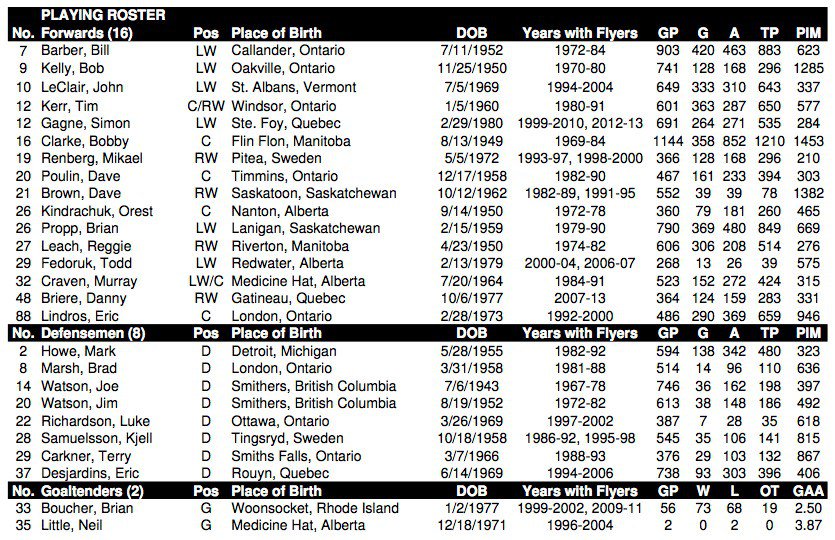
This week, the Flyers alumni have been practicing at the Skate Zone in Vorhees for this weekend's Alumni Game against the Pittsburgh Penguins. Here is the orange team, which is surprisingly balanced between the four decades of Flyers history:


The 1970s
Bill Barber
Bob Kelly
Bobby Clarke
Orest Kindrachuk
Reggie Leach
Joe Watson
Jim Watson

The 1980s
Tim Kerr
Dave Poulin
Dave Brown
Brian Propp
Murray Craven
Mark Howe
Brad Marsh

The 1990s
John LeClair
Mikael Renberg
Eric Lindros
Luke Richardson
Kjell Samuelsson
Terry Carkner
Neil Little (Phantoms)

The 2000s
Simon Gagne
Todd Fedoruk
Danny Briere
Eric Desjardins
Brian Boucher
Neil Little (Flyers)

A few notes on how I grouped these guys:
  • I had no idea that the Watson brothers were born more than NINE YEARS apart.
  • I tried to include players in the decade where they played the most games, had the most success, or were the most memorable. 
  • Neil Little was basically just a Phantoms goalie. That should be Ron Hextall's spot, but I guess he's too busy Not Buying Out Andrew MacDonald's Contract to have some fun. 
  • Another name that should be on this roster is Mark Recchi, who is now a coach in the Penguins system. He played for both Pennsylvania teams at points in his career, but he's not lacing up for either side for this game. It would kill me to see him not wearing orange and black, but I'd like to see him regardless. 
  • I included Desjardins in the 2000s group because that's when he took the C from Lindros. Will there be any tension between those two? Tune in Saturday to find out!
Except you can't tune in, because the game is only televised in the Philly market and only on TCN. They couldn't throw it on CSN Philly (the Sixers play at 8:00) or NHL Network (Penguins-Red Wings is on, so you can watch a non-divisional matchup featuring the worst team in the Atlantic) or NBC Sports (professional swimming is on, no seriously). 

So we're all going to be huddled around our computers watching the CSN Philly live stream. See you out there!